SPARK Communities of Practice
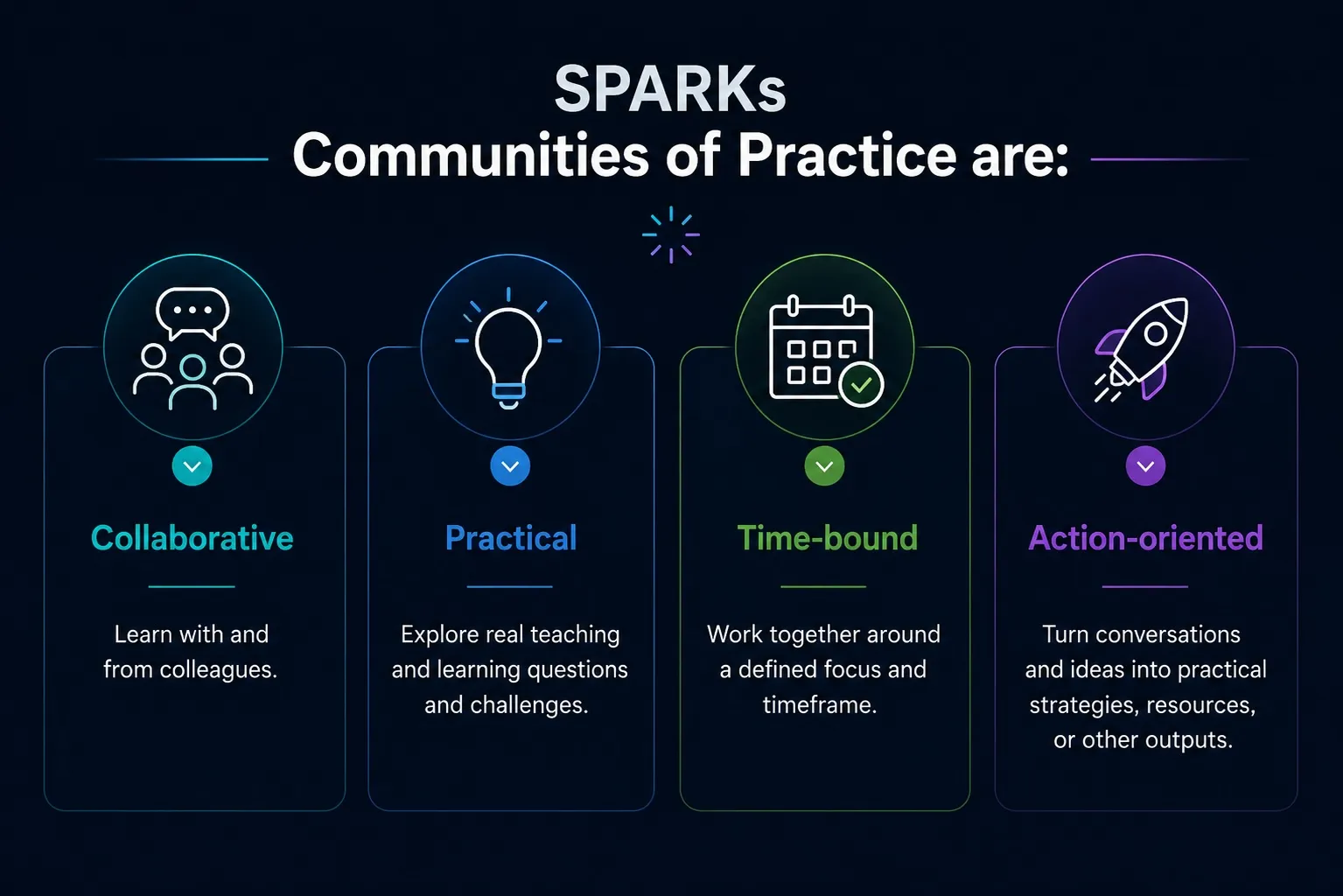
SPARK Communities of Practice (CoPs) bring Sheridan educators together to explore teaching and learning challenges, share experience and ideas, and turn conversation into practical action. Each CoP has a defined focus and timeframe, creating space for members to learn from one another, experiment, and contribute to Sheridan’s teaching and learning community.
CoPs are not traditional workshops. Members bring their own experiences, questions, and expertise to the conversation. Everyone has an opportunity to contribute, learn, and lead.
Explore Communities of Practice
Coming soon…
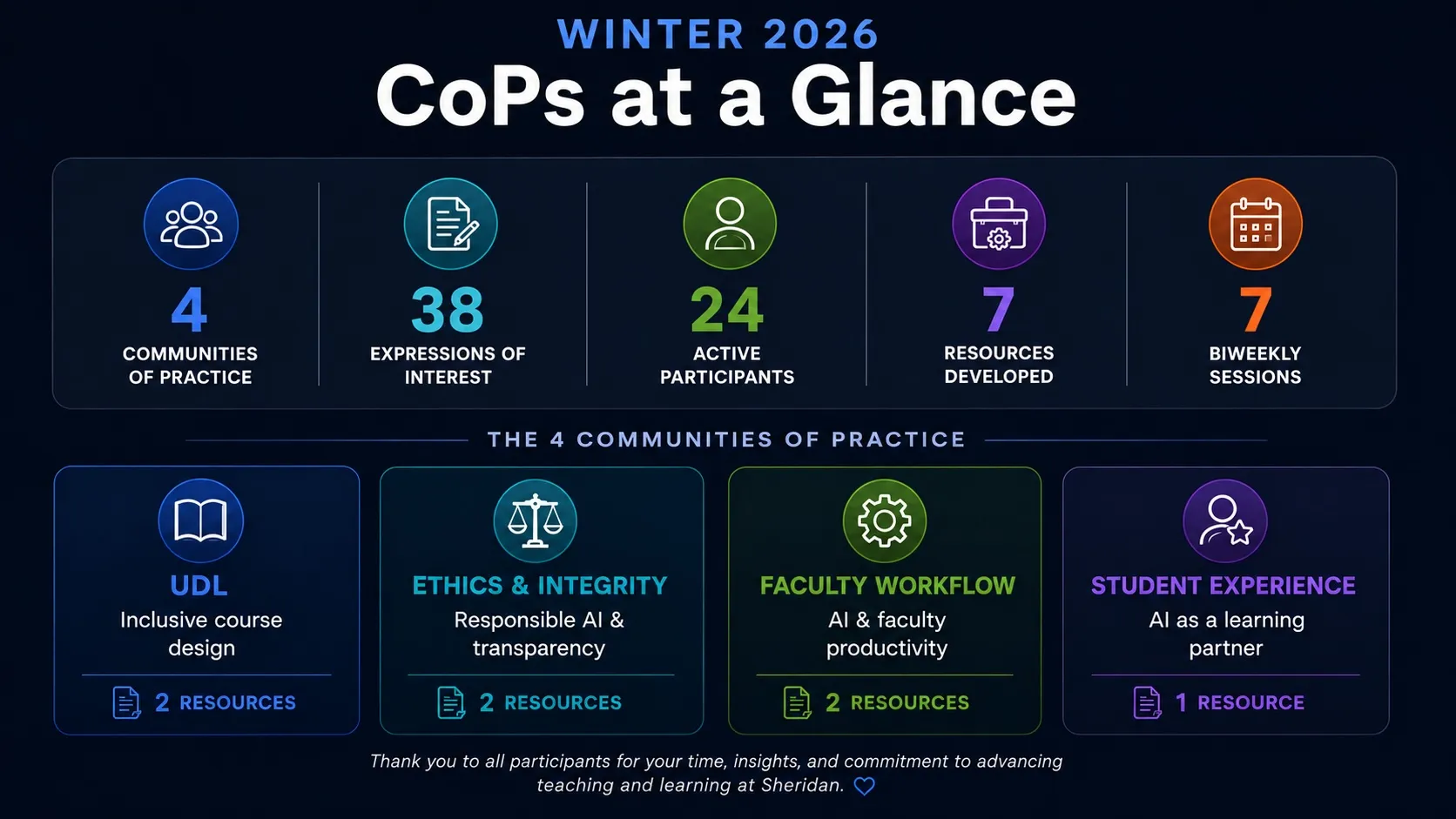
Winter 2026 was SPARK’s first Communities of Practice pilot, designed to explore the appetite for collaborative, practice-based learning across the Sheridan community. Four CoPs (UDL, AI Ethics & Integrity, AI Faculty Workflows, and AI Student Experience) met bi-weekly throughout the semester to explore shared teaching and learning questions and turn conversation into practical resources.
The pilot generated 38 expressions of interest, 24 active participants, and seven resources for the Sheridan community. Feedback showed strong interest in continuing CoPs, while also highlighting the need for more time, deeper conversations, and opportunities for cross-community collaboration.
What We Learned from Winter 2026
- Strong appetite: Participants expressed strong interest in AI-related conversations and future CoPs.
- Practical resources matter: The CoPs produced resources designed around real questions and challenges raised by participants.
- Time and commitment matter: Limited time and competing commitments affected participation and the depth of some conversations.
- There is room to grow: Participants identified opportunities for deeper discussion, broader topics, and more cross-institutional collaboration.

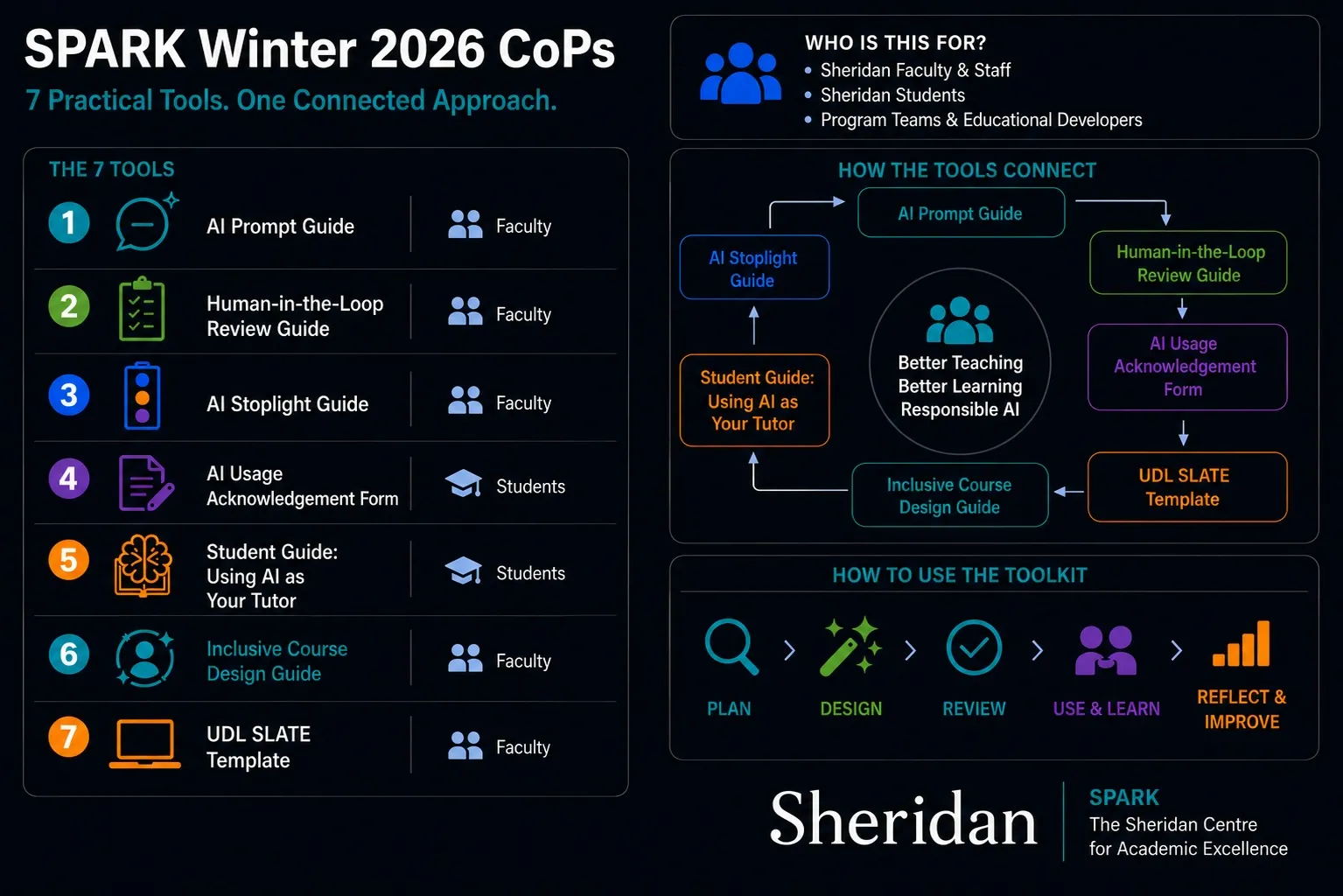
The Winter 2026 Communities of Practice turned shared questions and challenges into seven practical resources for the Sheridan community.
The tools are designed to support both faculty and students and can be used individually or together depending on the teaching or learning context.
Explore the resources:
-
AI Stoplight Guide
Audience: Faculty
A practical guide to help faculty establish clear expectations for AI use in their courses and assessments. Faculty can use the guide to identify when AI is permitted, permitted with disclosure, or not permitted, based on the learning outcomes and purpose of the activity. Use it when: Designing a course, assignment, assessment, or AI-use expectations.
-
AI Prompt Guide
Audience: Faculty
A collection of ready-to-use prompts to support common teaching and course design tasks, including course planning, assessment development, and student support.
Use it when: You want to use AI to save time or support a teaching or course design task while maintaining your professional judgment.
-
Human-in-the-Loop Review Guide
Audience: Faculty
A practical guide for reviewing AI-generated teaching materials before they are shared with students. It helps faculty consider accuracy, representation, inclusion, pedagogy, transparency, and Sheridan alignment.
Use it when: AI has generated or helped develop course materials, activities, examples, assessments, or student-facing content.
-
Inclusive Course Design Quick Check
Audience: Faculty
A short, UDL-informed checklist to help faculty review their courses for clarity, accessibility, flexibility, and learner support.
Use it when: Designing or reviewing a course, SLATE site, learning activity, or assessment.
-
UDL SLATE Template
Audience: Faculty
A customizable SLATE course template designed to support accessible, consistent, and learner-centred online learning. The template provides a clear structure for organizing course content, communicating expectations, and supporting student navigation and engagement.
Use it when: Building or refreshing a SLATE course site.
-
AI Usage Form
Audience: Students
A simple way for students to document and reflect on how they used AI in their coursework when AI use is permitted or requires disclosure.
Use it when: An instructor asks you to disclose your use of AI in an assignment or learning activity.
-
Using AI as Your Tutor
Audience: Students
A collection of practical prompts that help students use AI to understand, practise, reflect, and build skills rather than simply generate answers.
Use it when: You are stuck, want to test your understanding, practise a skill, plan a project, or identify gaps in your learning.
What’s Next?
Communities of Practice are an ongoing part of SPARK’s work. Future CoPs will respond to emerging needs and interests across the Sheridan community, creating opportunities to explore ideas, share practice, and develop practical resources together.
Fall 2026 CoPs are currently being planned. Check back here for upcoming themes and registration opportunities.
Get Involved
Want to be part of a SPARK Community of Practice?
Communities of Practice are shaped by the needs and interests of the Sheridan community. Whether you want to join a future CoP, suggest a topic, or share feedback, we’d like to hear from you.
Use the form below to:
- Join a Future CoP — Register your interest in participating in an upcoming CoP.
- Suggest a Topic — Share a teaching or learning challenge you’d like to explore with colleagues.
- Share Feedback — Tell us about your experience with a CoP or one of the resources developed.

Have a question or need support with something else? Connect with SPARK Support.